


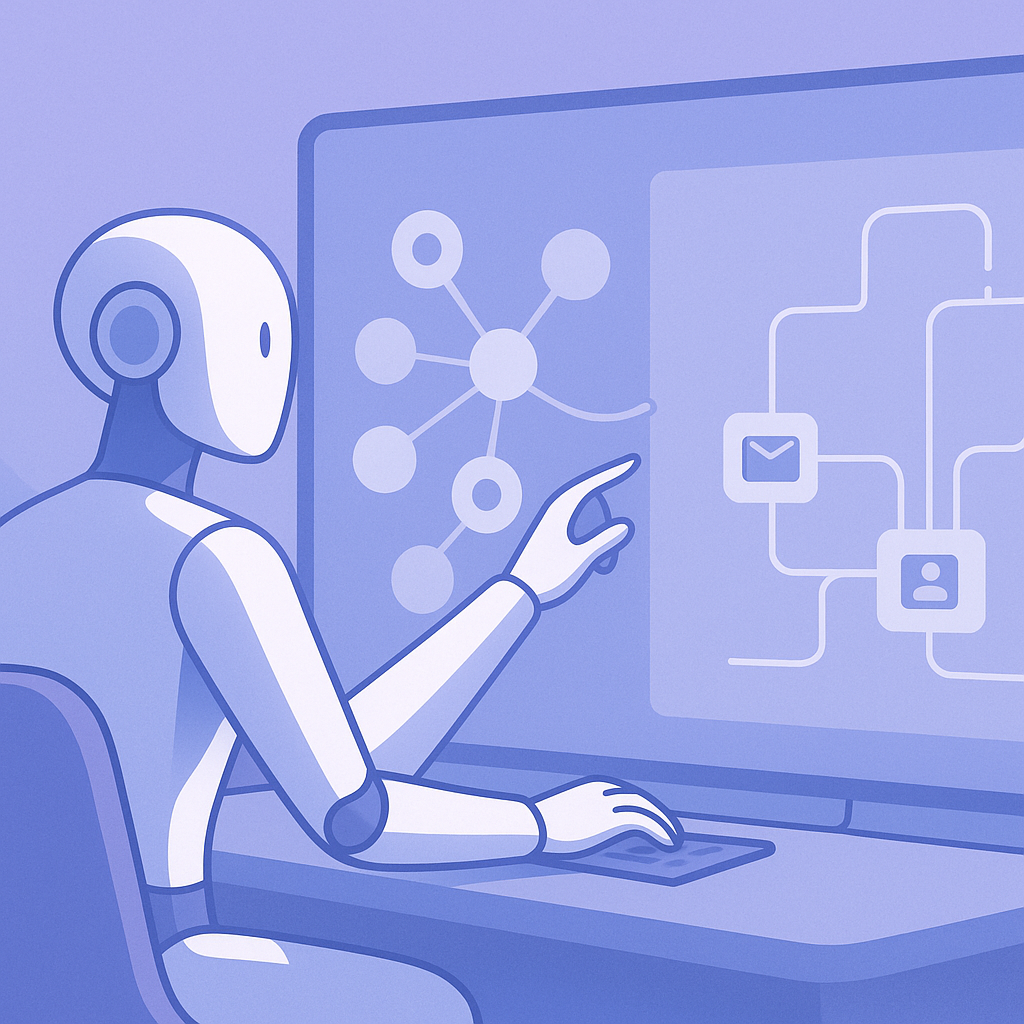
If your marketing team still relies on someone manually reviewing every incoming lead, qualifying their interest and deciding the next step, you know the cost of scaling that operation. This is where AI agents in marketingsystems capable of working autonomously for hours or days, making decisions and executing actions without anyone monitoring every step.
For years, the promise of marketing automation has relied on predefined workflows: if the lead does X, send Y. It works, but it has a clear ceiling. As soon as the situation goes off-script, the system falls short and someone from the team has to step in.
AI agents change that equation. They don't follow a rigid script: they interpret context, consult information, choose between various options and execute chained tasks without constant supervision. The question that interests you is not whether this technology exists, but whether it makes sense for your specific operation and how to implement it correctly.
From chatbots to AI agents: what has really changed
A traditional chatbot answers questions within a closed flow. It is useful for resolving frequently asked questions or filtering basic contacts, but it stops as soon as the conversation gets complicated.
An AI agent operates differently. It can receive a broad objective — for example, «qualify this lead and schedule a meeting if they meet these criteria» — and work autonomously to achieve it: it checks the CRM, reviews the interaction history, drafts a personalized email, waits for a response, adjusts the message if there's no reaction within 48 hours, and escalates to a human sales rep only when appropriate.
The difference is not just technical
The real difference lies in sustained autonomy over time. A chatbot resolves a single interaction. An agent can maintain an active nurturing sequence for weeks, adapting to the behaviour of each contact without anyone having to rewrite the flow every time something changes.
What can an AI agent do in demand generation today
In marketing and sales processes, the most mature use cases right now are:
- Real-time lead scoringanalyse forms, web behaviour and enrichment data to prioritise who to contact first.
- Adaptive nurturingadjust the content and timing of each communication according to how each contact responds, not according to a fixed schedule.
- Conversational qualificationmaintains an email or chat conversation to understand needs before passing the lead to sales.
- Autonomous meeting schedulingcoordinate availability and confirm appointments without human intervention.
None of these cases replace the content strategy or brand positioning. They are time-consuming operational processes for the team that benefit from agent autonomy.
When an AI agent is better than traditional automation (and when it is not)
An AI agent delivers real value when there is variability in the process: every lead responds differently, context needs to be interpreted or the volume is too high for a human to review every case. If your qualification process changes a lot depending on the prospect, fixed rule-based automation quickly falls short.
Conversely, if your workflow is simple and predictable — a sequence of three emails after downloading an ebook, for example — a well-constructed traditional automation remains the most efficient and cheapest option. Setting up an agent for something that a workflow solves just as well is needlessly complicating things.
How to implement it without breaking your current stack
Most failures in AI agent adoption do not come from the technology, but from the foundation upon which it is built. If your contact data is duplicated between the CRM, the email tool, and the sales team's spreadsheets, an agent will make decisions based on incomplete or contradictory information. We already discussed this problem in detail in how to unify your marketing stack with AI, and it is the preliminary step that many companies skip.
Before activating an agent in production, it is advisable to:
- Define precisely the objective and the limits of autonomy (what can be decided independently and when it must be escalated to a person).
- Verify that the data the agent will query is clean and centralised.
- Start with a bounded process —for example, initial qualification only— before expanding the scope.
- Establish periodic reviews of the decisions you make, at least for the first few weeks.
Real metrics to measure success
Beyond the feeling that it «works well», it is worth measuring with concrete figures:
- First response time to a new lead (lead management studies have been showing for years that responding within the first few minutes multiplies the conversion probabilities compared to doing so hours later).
- Lead to booked meeting conversion rate, comparing the process with and without an agent.
- Manual working hours freed up in the marketing or operations team.
- Cost per qualified lead, including the cost of the tool.
Without this data, it is impossible to know whether the agent is providing real value or simply automating something that was already working reasonably well.
An idea to take with you
AI agents in marketing are not an upgraded version of the chatbots you already know: they are a leap in autonomy that only makes sense if your process has enough complexity to justify it and your data is in a condition to sustain it. Before asking yourself which agent to implement, ask yourself which specific process in your demand generation loses the most time and quality due to a lack of personalisation at scale. That is where it is worth starting to test.
