


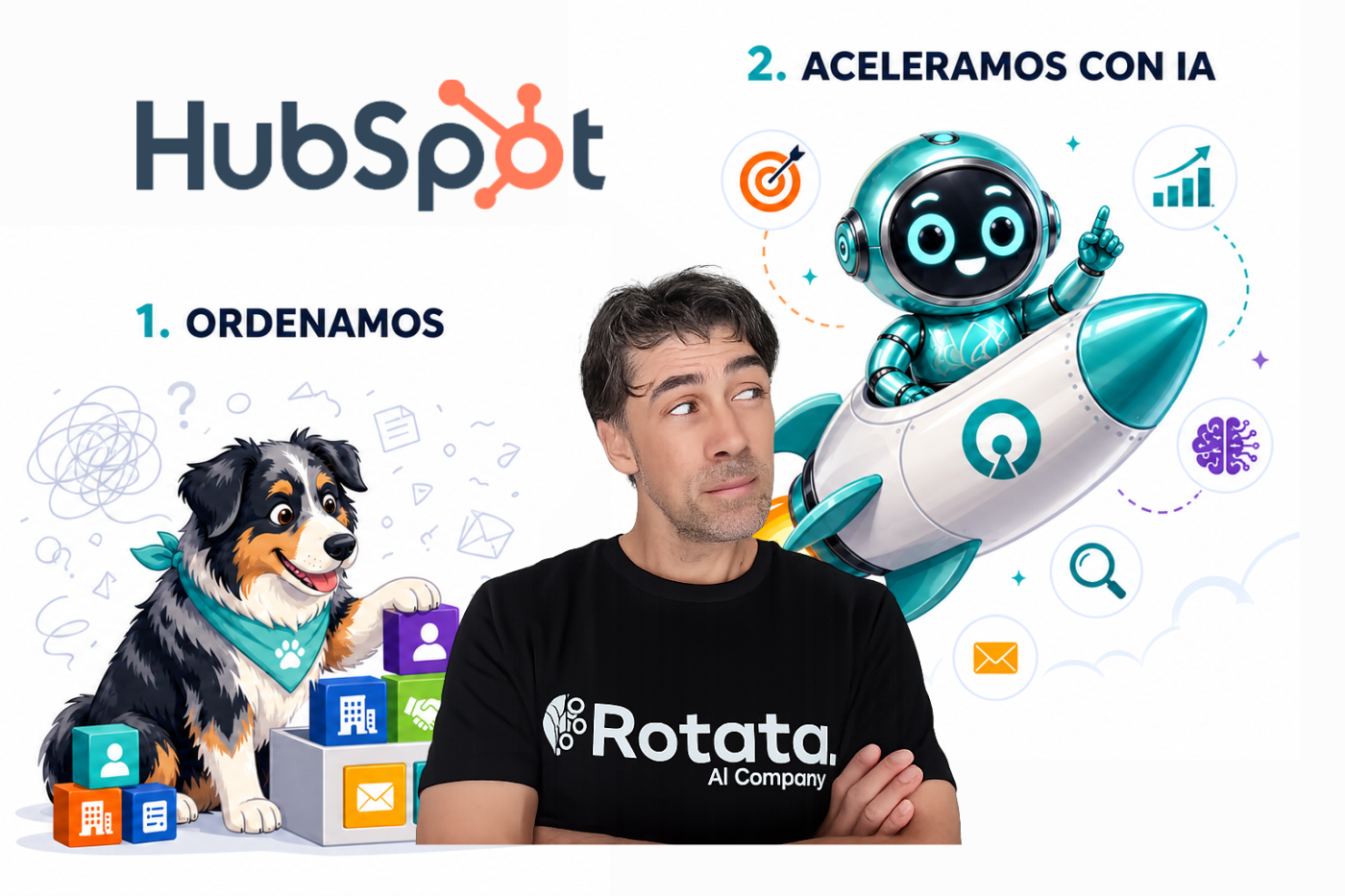
From organising HubSpot to building growth
In the previous article «Structural errors in HubSpot distorting your reports»we were talking about a very common reality: many companies have HubSpot, but their reports do not always accurately reflect what is happening in your business process.
When this happens, it's usually not a limitation of the tool, but an opportunity to improve how the system has been designed: the data model, the relationship between leads and opportunities, the definition of sales stages, the use of the lifecycle, or the construction of dashboards.
That was the first step: tidying up the house. Because if the CRM doesn't have a clear structure, any subsequent automation will be more fragile, and any artificial intelligence initiative will work on an inconsistent foundation. Technology can be very powerful, but it needs a well-thought-out business architecture to deploy its full value.
But today I want to take a step further with you. Once HubSpot it's well organised, the question should no longer be solely about how to get better reports. The question should be much more ambitious: how to transform HubSpot in a commercial system capable of generating demand, prioritising opportunities and helping the team to sell better.
That's where the really interesting conversation begins.
HubSpot as a growth platform, not just a CRM
For a long time, many companies have used CRM as a sort of business archive. A place to store contacts, companies, deals, calls, emails, and tasks. A useful system, to be sure, but often more geared towards documenting what has already happened than driving what should happen next.
And that difference is enormous. Because one thing is to have a CRM that records activity, and quite another is to have a sales system that helps create opportunities.
When HubSpot It is well designed, it should not be limited to answering questions about the past, such as how many leads arrived, how many meetings took place or how many opportunities were closed. It should help you answer much more valuable questions: which companies you should pay attention to now, which accounts are showing signs of interest, which leads deserve immediate follow-up, which messages are generating real conversation, and what part of the pipeline is born from truly qualified demand.
That's the leap: moving from an administrative CRM to a business growth platform.
Demand generation is no longer linear
In B2B sales, demand generation has changed. For years, many companies have worked with a fairly linear logic: launch campaigns, capture leads, qualify them, pass them to sales, and hope that a portion of them convert into opportunities.
That model still makes sense, but today we have access to many more signals than before. We can know which companies visit certain pages, what content they consume, what job titles interact with our campaigns, what topics generate interest, what accounts are similar to our best customers, and what behaviours can anticipate future purchase intent.
This is where data intent tools, advanced automation and AI agents come into play.
But I want to be very clear with you: these tools do not replace business strategy. They amplify it.
A data intent system can help you identify companies that are investigating a problem related to your solution. An AI agent can help you prepare messages, summarise interactions, detect signals, propose next steps, or speed up repetitive tasks. HubSpot you can centralise that information, connect it to your business process and turn it into concrete actions.
For all of that to work well, you need a solid foundation. If your sales stages aren't clear, if your contacts aren't properly associated with companies, if your deals are created without criteria, or if you can't differentiate between an interested lead and a real opportunity, AI won't elevate the system to the level you expect. Instead, when the structure is well designed, artificial intelligence can become a very powerful acceleration layer.
First criteria, then automation
That's why I like to say we first get organised and then accelerate. Artificial intelligence applied to sales doesn't start with the prompt, or the agent, or the automation. It starts with system design.
Start by deciding how your company understands demand generation, what a qualified lead really means, when sales should get involved, what signals indicate real intent, what criteria justify creating an opportunity, and what information management needs to make decisions.
Once that is clear, HubSpot it can become an extraordinarily powerful platform, because we are no longer just talking about having data, but about making the data work for you.
Imagine, for example, that a target company visits a service page several times, interacts with technical content, belongs to a priority sector, is the right size, and also shows external signs of actively searching for a similar solution. In a poorly connected CRM, that information could be scattered across properties, forms, emails, and sales notes. In a well-designed system, that signal should trigger an action.
It can generate a sales task, initiate a personalised sequence, ask an AI agent to prepare an account summary, recommend an industry-tailored message, alert the sales manager, enrich the company profile or prioritise that account over others with a lower likelihood of conversion.
That's no longer simply “using" HubSpot”That's building a smart trading system.
The real role of AI agents
It's advisable to maintain a balanced perspective. I don't believe AI agents should replace the business relationship, especially in complex B2B sales. Trust, contextual understanding, negotiation, empathy, and political reading of an account remain profoundly human.
But I do believe AI agents can remove a lot of friction from the business process.
They can help you research an account before a meeting, summarise previous conversations, propose need hypotheses, draft an initial message, adapt a proposal to a sector, suggest questions for a discovery call, spot dormant opportunities, or identify patterns in reasons for loss.
The key is not to see them as a technological fad, but as a layer of operational intelligence around the business process.
and there HubSpot it plays a very relevant role, as it concentrates a large part of the information these agents need to be useful: contacts, companies, interactions, deals, campaigns, forms, emails, meetings, tasks, notes and historical activity. The better structured that information is, the more value the agents can provide. The more dispersed it is, the more difficult it will be to transform that data into useful decisions.
A more predictable system
When I talk about building a more predictable sales system, I don't mean having a crystal ball. I mean something much more practical: being able to identify earlier which accounts warrant attention, which opportunities require follow-up, which campaigns are generating real demand, and which sales actions are producing progress.
Commercial predictability is born from connecting signals. A website visit can be just a visit. A download can be just a download. A LinkedIn interaction can be just an interaction. An email open can be just an open.
But when several signals stack up on an account that fits your ideal customer profile, the conversation changes. That's where HubSpot, combined with data intent and AI agents, can help you move from reactive selling to more proactive selling.
You don't just wait for someone to ask for a demo. You start detecting interest before it's explicit. And that, in competitive markets, makes a huge difference.
A more scalable system
It's also worth clarifying another important idea: scaling sales doesn't mean sending more messages.
In fact, one of the great confusions of many modern business strategies is equating automation with volume. More messages don't necessarily mean more opportunities. More sequences don't necessarily mean more sales. More leads don't necessarily mean more quality pipeline.
Real scaling means being able to reach the right accounts better, with the right message, at the right time, and with consistent follow-up.
HubSpot this can help you build that system because it allows for better segmentation, better personalisation, better coordination of marketing and sales, avoiding duplication, measuring which messages generate a response, detecting which leads are going cold, reactivating old opportunities and maintaining a sales cadence without relying solely on the team's memory.
With AI agents, you can also add an extra layer of quick customisation, context analysis, next-action recommendations and more efficient commercial preparation. But the aim isn't to fill the world with automated messages. The aim is for every interaction to make more sense.
A more measurable system
And when we talk about measurement, something similar happens. If you're a sales director, marketing director, or CEO, you probably don't need more graphs. You need better decisions.
For that, HubSpot It should help you connect three worlds that often work too separately: marketing, sales, and management.
Marketing needs to know which campaigns are generating real opportunities, not just leads. Sales needs to know which accounts to prioritise, not just which contacts have responded. Management needs to know which actions are creating pipeline and what forecast they can defend.
That's the reporting that matters. Not the decorative dashboard, not the table that's looked at once a month and doesn't change any decisions, not the report full of metrics that nobody uses.
A measurable sales system should help you understand which channels generate the best opportunities, which segments convert best, which messages open real conversations, which campaigns influence pipeline, which opportunities become blocked, which loss reasons are repeated, which accounts show intent but are not followed up on, and which sales actions accelerate closing.
When you can see that, HubSpot stops being a tool of control and becomes a tool of direction.
The true opportunity: uniting process, data, and intelligence
For me, the true value is not in HubSpot Separately. Nor is it in AI separately. Nor in the data intent separately.
The value emerges when everything comes together within a coherent system: a clear business process, an organised database, a shared definition of lead and opportunity, a well-focused demand generation strategy, intent signals that help prioritise, AI agents that reduce manual work, automations that trigger useful actions, and dashboards that enable decision-making.
That's what makes a company sell better. Not having more technology, but having a smarter business architecture.
Conclusion: From CRM Implemented to Intelligent Business System
HubSpot It can be many things. It could be a database, a tracking tool, a reasonably well-configured CRM, or a place to log calls, emails, and opportunities.
But it can also become something far more valuable: the system from which your company generates demand, detects intent signals, prioritises accounts, triggers sales actions, deploys AI agents and measures what’s truly contributing to growth.
That is the leap many companies still have to make, as the CRM needs to be organised first, because without that, everything else loses consistency. But once the structure is well designed, the next step is not to add more complexity, but to build commercial intelligence around that structure.
Because the future of B2B sales isn't about chasing more leads, sending more messages, or filling the CRM with automations. It's about better understanding where demand lies, acting sooner, prioritising better, and measuring more accurately what generates business.
And there, well used, HubSpot It can be much more than a CRM. It can be the platform on which you build a more predictable, scalable, and measurable business system.
