


Need to generate more leads? Rely on LinkedIn for B2B lead generation.
LinkedIn is a conversational network, it seeks debate.
If you think of LinkedIn for B2B lead generation you are well on your way, LinkedIn is no longer just a showcase for sharing professional achievements. It is much more: it has become a conversational sales channelLinkedIn is especially valuable for B2B businesses looking for new opportunities without resorting to traditional methods such as cold calling (which is becoming less and less useful) or mass email marketing. While the temptation to use LinkedIn as a simple marketing megaphone is strong, the real success lies in understanding that, at its core, this platform is first and foremost a space for genuine conversation, where human connections precede any commercial intent.
It seeks to help, not to lecture.
No one logs on to LinkedIn expecting a sales pitch. Just like a dinner party between professionals, the first contact should aim to start a sincere conversation, not force a sale. It is essential to change the approach: instead of "closing meetings" from the first message, the initial objective should be to provoke a response, open a genuine dialogue and find points of common interest. It is about building relationships that, over time, can be transformed into real and sustainable business opportunities.
The importance of your profile.
To realise the full potential of LinkedIn, I recommend that you start with yourself, with your own profile. You need to stop thinking of it as a mere online CV and transform it into a landing page that speaks for and to your potential clients, not your professional achievements. An effective profile should answer three questions clearly and convincingly:
- Who are you?
- What do you do for your clients?
- Why should they trust you?
Regarding the headline, instead of just describing the position you hold, I recommend that you reflect in a concrete and attractive way the value you bring. A message like "I help B2B companies scale their demand generation with AI" has a much greater impact than a generic "Marketing Director". Of course, forget "Account Manager", they are an invitation not to contact you.
What do you think of this one?
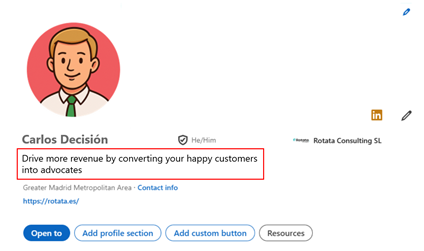
The profile picture also plays a crucial role: conveying professionalism and approachability can be as simple as a natural smile captured by a professional photographer. I recommend that you invest in good photography; it is, in fact, investing in your personal brand. Forget selfies and photos in a football stadium.
Generate content and participate.
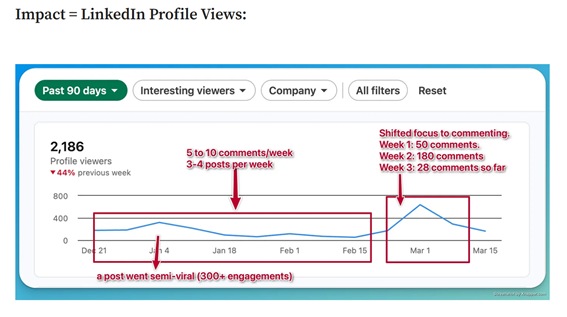
However, optimising your profile is not enough. You have to be present: commenting, posting and sharing relevant content is part of an active strategy that boosts visibility and credibility. On LinkedIn, comments have even more impact than your own posts when it comes to increasing organic exposure. Every smart comment is an additional touch point, an opportunity to show expertise and generate genuine interest.
Take a look at this image (see biography at the bottom of the document):
The content you share on LinkedIn should be carefully designed to generate value. Real customer stories that illustrate their before and after, trend analysis, short videos that share unique insights, and data-driven comparisons are the formats that truly capture attention. Every post should be an invitation to conversation, not a promotional monologue.
Contact directly, don't delegate.
When it comes to prospecting, I recommend that you get directly involved. Don't completely delegate this task to assistants, a big mistake I have personally made in the past, as the first conversations shape the prospect's perception of your organisation. You can use playbook automation tools such as The Growth MachineBut you have to be in control at an early stage of the conversation to succeed.
When it comes to automation, it is imperative that you strike the right balance. Automating repetitive tasks, such as scheduling mailings or collecting data, can free up valuable time, but should never eliminate genuine personalisation. Ideally, at least 20% of every message should be tailored specifically to the context and needs of the recipient. It is this attention to detail that makes the difference between being ignored and being remembered.
I also recommend that you explore new communication formats - have you thought about sending videos or voice messages?
We are all very used to receiving text messages, but we receive far fewer videos and voice messages, which you can record with the LinkedIn app on your mobile. If you want to be different, it's time to take the plunge. If you can write a text of interest, I'm sure you can also record it as a voice message or even a video. Bring out your reporter side and dare to do something different. Again, test and measure the results; remember that there are no magic formulas and often controlled "trial and error", the famous A/B tests, should be a relevant part of your B2B strategy.
Choose your audience carefully.
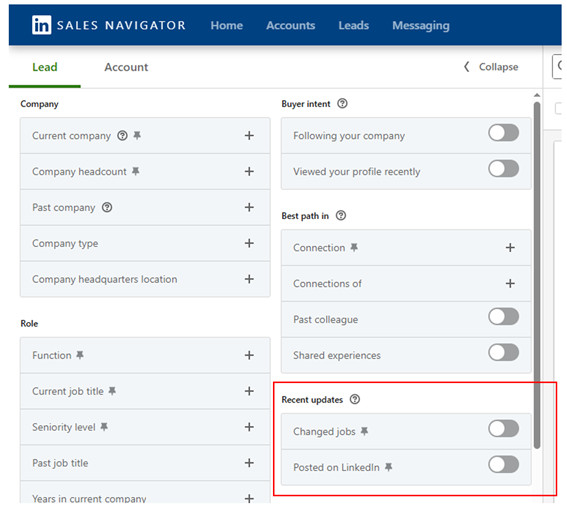
Prospecting does not mean firing off messages indiscriminately. It is a task of surgical precision: searching for profiles that fit perfectly with a well-defined ICP (Ideal Client Profile), filtering by industry, position, company size and, fundamentally, by their recent activity on LinkedIn. In LinkedIn Navigator you have special filters to find out which users are active on LinkedIn and which are not. Trying to contact inactive profiles not only consumes resources, but also saps the team's morale.
-LinkedIn for B2B lead generation-
I have material, an excellent profile and a list of potential clients, now what?
Now it's time to connect, and the way to connect also requires strategy and subtlety. There are different schools of thought: some experts advocate sending connection requests without a message, relying on a well-optimised profile to speak for itself; others prefer to accompany the request with a short personalised message. For example: "Hi Elena, I've seen your work in the IT sector. We at Rotata help companies like yours to improve lead conversion with AI without expanding their team. Shall we connect? The key is to be brief, direct and relevant.
As always, you can do A/B tests to see what works best in your specific case. Personally I prefer to either leave it blank and let my profile speak for me, or use a short message aimed at a specific problem and with a challenging message, always without being aggressive.
Once the connection is established, the pace of interaction should be natural and respectful. For the first few days, I recommend sending a sincere thank you message, accompanied by some useful content to open the dialogue. If there is no response, a few days later you can share an additional resource or a relevant reflection. Pushing aggressively is often counterproductive; sometimes the timing is simply not right, and it is wisest to keep the door open for future opportunities.
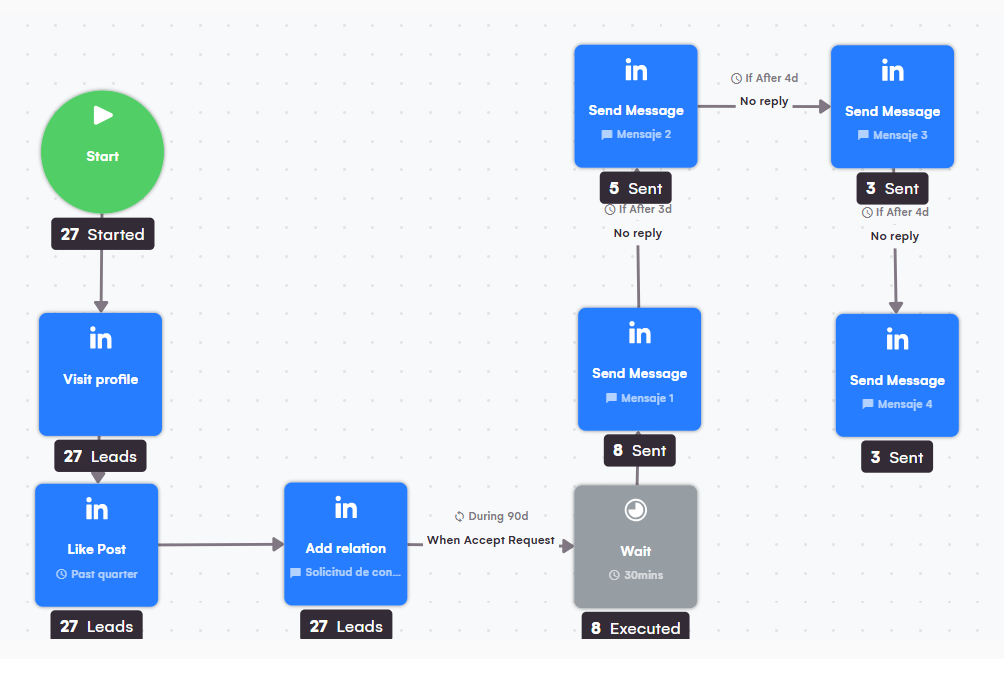
Here is a suggested sequence:
- Day 1-2: Say thank you for the connection and share a useful tip.
- Day 3-5: If this does not get a response, provide more content of value, without losing the focus of the issue you are raising.
- Day 6-8: If there is still no response, make one last attempt by offering a conversation of value or some content of interest.
- Day 10-12: If we finally fail to start a valuable conversation, make a graceful closing: share interesting content or say goodbye with professionalism.
This sequence could be automated with the tool "...".The Growth Machine"but only up to the first response:
We are already using LinkedIn for B2B lead generation. How do we now measure the success of our campaigns?
Forget vanity metrics like likes or followers. Measuring results is essential, but knowing what to measure is even more so. Beyond "likes" and followers, the truly relevant indicators in a B2B strategy are:
- Response rate to your messages,
- Accepted connection rate,
- Qualified leads generated,
- Meetings scheduled.
Analysing this data will allow you to fine-tune your strategy, identify areas for improvement and maximise the return on every effort invested.
One last piece of advice.
And finally, one principle you should never forget: on LinkedIn, consistency and authenticity are worth more than any fleeting attempt at virality. It's not about posting content that explodes one day and disappears the next. It is about building, day after day, a credible, solid and relevant presence. Posting at least twice a week, interacting with the network on a daily basis and maintaining a flexible but consistent editorial calendar can make a radical difference in the medium and long term.
With strategy, patience, authenticity and a human touch, LinkedIn can move from being just another social network to become the lifeblood and sustainable growth engine of any B2B business aiming to dominate its industry.
With all this you are now in a position to make the most of your B2B strategy on LinkedIn. If you want to take your lead generation to the next level and transform LinkedIn into a recurring source of real opportunities, at Rotata we can help you plan and manage effective, data-driven and personalised campaigns. Plus, we'll show you how to integrate cutting-edge tools such as HubSpot o The Growth Machinewhich incorporate Artificial Intelligence to automate key processes and maximise results.
Contact us today and schedule a free diagnostic session. Take the first step towards a smart and scalable B2B strategy with LinkedIn.
References and further reading:
