



By Ignacio San Luis Castellano, CEO of Rotata
Have you noticed that, in many searches, Google's Generative Search (GSE) already shows an AI response before links to web pages?
- Your sector is already on the radar of the generative search (GES); The uncertainty is how much affects you today.
- Visibility is redistributes: wins whoever wins citable and reliable, not who publishes the most.
- The experiment shows that language e intention trigger SGE differently; measure this in your consultations.
- Acts with 5 levers: quotable answers, brand trust, orderly knowledge, unique content y measurement + key accounts (ABM).
Introduction: a silent (but radical) paradigm shift
In recent months, Google has started to showcase a completely new version of its search engine. It has not done so with major advertising campaigns or logo changes, but the impact of this transformation could redefine the rules of the game for all businesses that rely on online visibility. This new experience, known as generative search (SGE) (Search Generative Experience), uses advanced language models to provide complete answers to users' questions without requiring them to click on any links. The information appears directly generated by AI, at the top of the search engine, displacing traditional results.
This marks the birth of a new paradigm: from SEO (Search Engine Optimisation) to IAO (Intelligent Answer Optimisation).
And although, as we will see below, this change does not yet affect all sectors equally, all companies and, as far as I am concerned, those of IT Services & Consulting, We should anticipate: the search experience is evolving in our industry, where purchase decisions are complex, the commercial cycle is long and brand trust is key. Is your company ready to compete in an environment where the click is no longer the primary conversion vehicle?
The rules of positioning are changing (and no one has told you)
Until now, SEO was based on optimising titles, links, keywords and content structure in order to appear among the first results in Google. This is still important, but it is no longer enough.
With the advent of the IAO, the rules are rewritten:
- Your content should be cited by AI, not just indexed by Google.
- Your brand authority gains weight, because the AI prioritises “trusted and relevant” sources.
- Context matters more than keywords: AI looks for semantic patterns, coherence and intent.
- Alternative formats (podcasts, videos, structured data, user reviews) are gaining prominence.
In other words: your brand is no longer competing just to appear; it is competing to be credible in the eyes of a machine..
How will Google's generative search (GFS) affect B2B search in 2025?
Over the last few years, many analysts anticipated a dramatic drop in organic traffic due to the rise of the “...".“zero-click traffic”. However, recent reports suggest that these predictions may have been exaggerated. In fact, according to an article published in PuroMarketing in January 2025, The reality is that the zero-click is not happening in the radical way that was feared (PuroMarketing, 2025). Google's AI has not eliminated the click, but is changing how and where it happens.
In short, we are not facing the end of organic traffic, but we are facing a profound transformation in visibility patterns. The clicks have not disappeared, but they are being redistributed according to the value, authority and structure of the content we offer.
For a company like yours, this has direct consequences:
- Your website may appear as a source of information... but the user will never visit it if the summary already solves their question.
- Your content can feed Google's AI... but without explicitly mentioning you.
- Your positioning strategy can be impeccable... and still not generate opportunities if it is not adapted to the new search format.
The new search environment: How does Google answer your customers' questions?
Google's behaviour with regard to the use of the CMS is based on criteria that depend on many factors. To illustrate this, we have conducted a small experiment: let's assume that a customer wants to search for CRM (Customer Relationship Management) software for his company and formulates various queries on Google.
In a first attempt we entered the following query in English: “crm software for small companies” and the result was an activation of SGE (see Fig. 1).
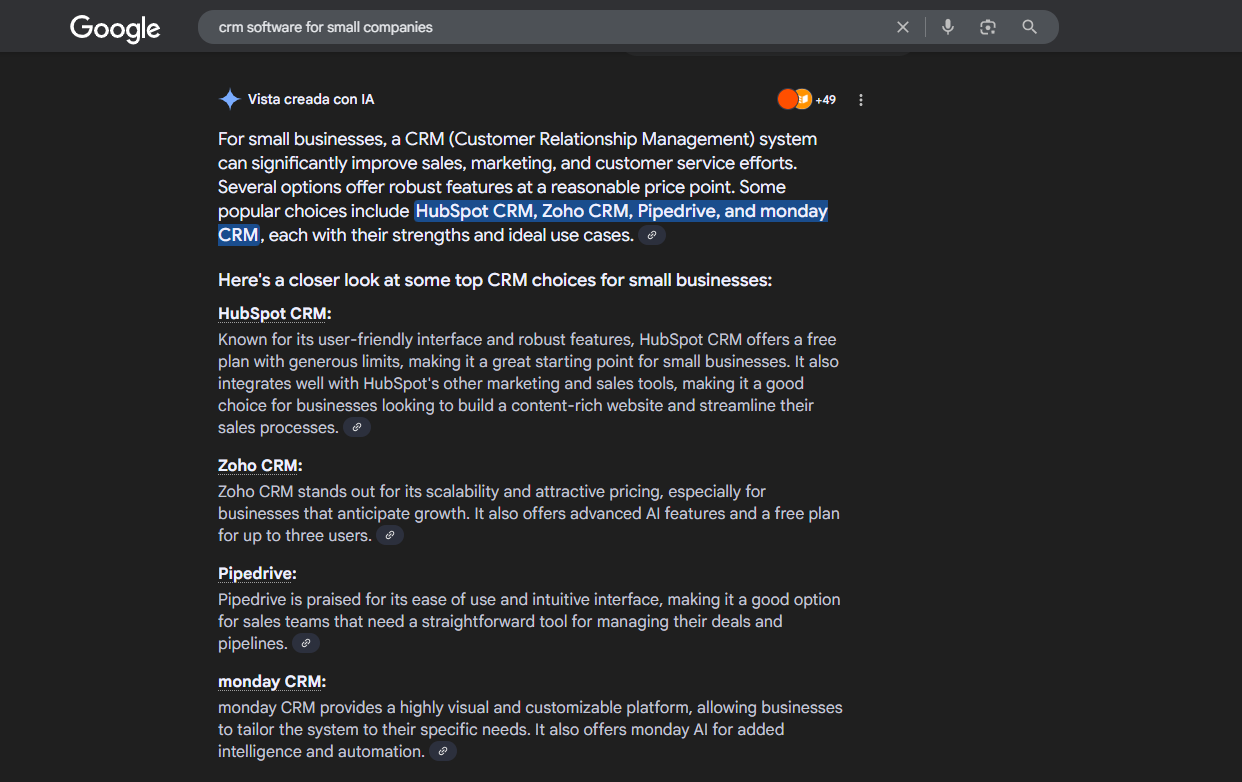
English SERP with active SGE showing list of CRMs](sandbox:/mnt/data/Capture 1.PNG) Fig. 1 - English query (“crm software for small companies”): Active SGE with list of tools. Screenshot taken in August 2025 (Spain, desktop, session not logged in).
However, when we changed the phrase to a very similar one, but in Spanish - “Busco software de gestión de clientes para pequeñas empresas”-, the result was a more traditional response, without activation of the SGE, where the sponsored content appears at the top of the results page (SERP) (see Fig. 2).
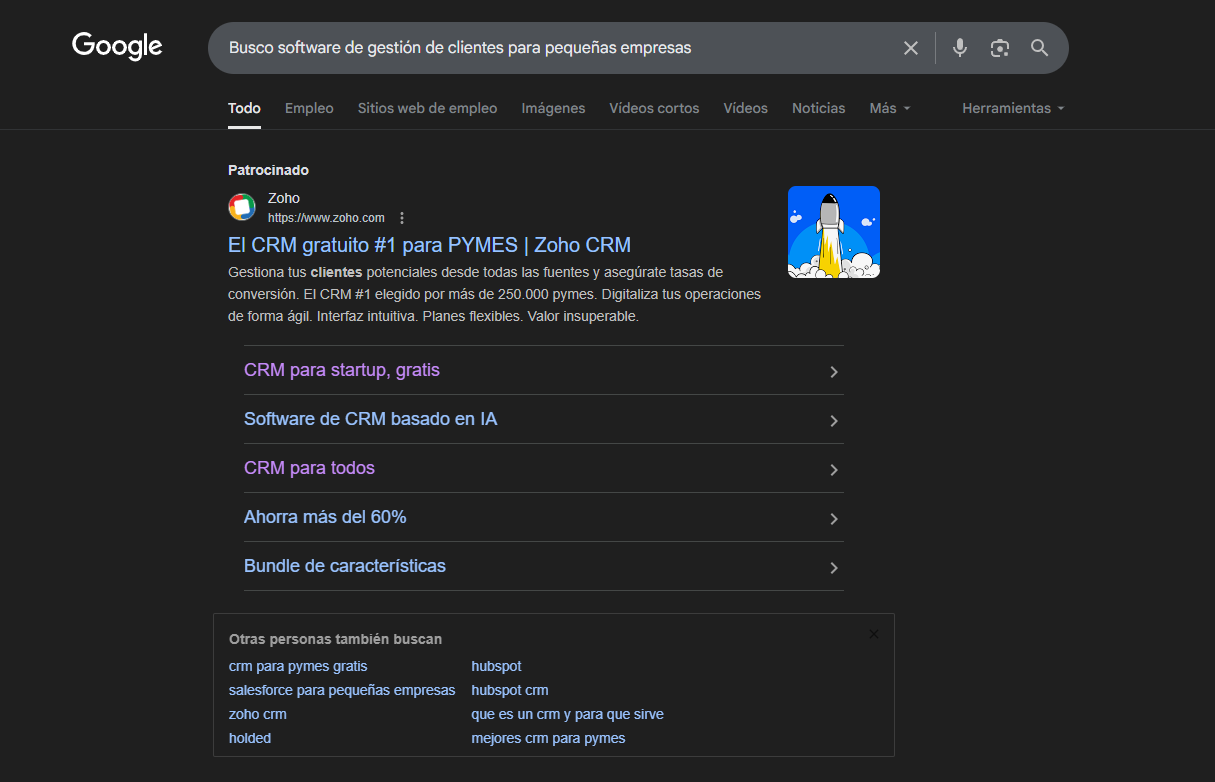
Spanish SERP without SGE with featured ad](sandbox:/mnt/data/Capture 2.PNG) Fig. 2 - Specific Spanish query (“Busco software de gestión de clientes para pequeñas empresas”): no SGE; priority to ads. Screenshot taken in August 2025 (Spain, desktop, session not logged in).
We have repeated the consultation on CRM software combining Spanish and English using similar phrases and have drawn several conclusions:
Conclusions of the experiment
- English queries almost always bring the SGE to the top of the list, sometimes as the first choice, sometimes right after the sponsored content.
- Spanish queries are most often answered in the traditional way (without SGE), but as the phrase becomes more generic, a response that includes SGE is more likely.
- If we use a more generic phrase in English, it is more likely to trigger the SGE. The query “CRM solutions” did trigger the SGE, as we see in Fig. 3, probably because Google interprets that you may be looking for information on what a “CRM” is.
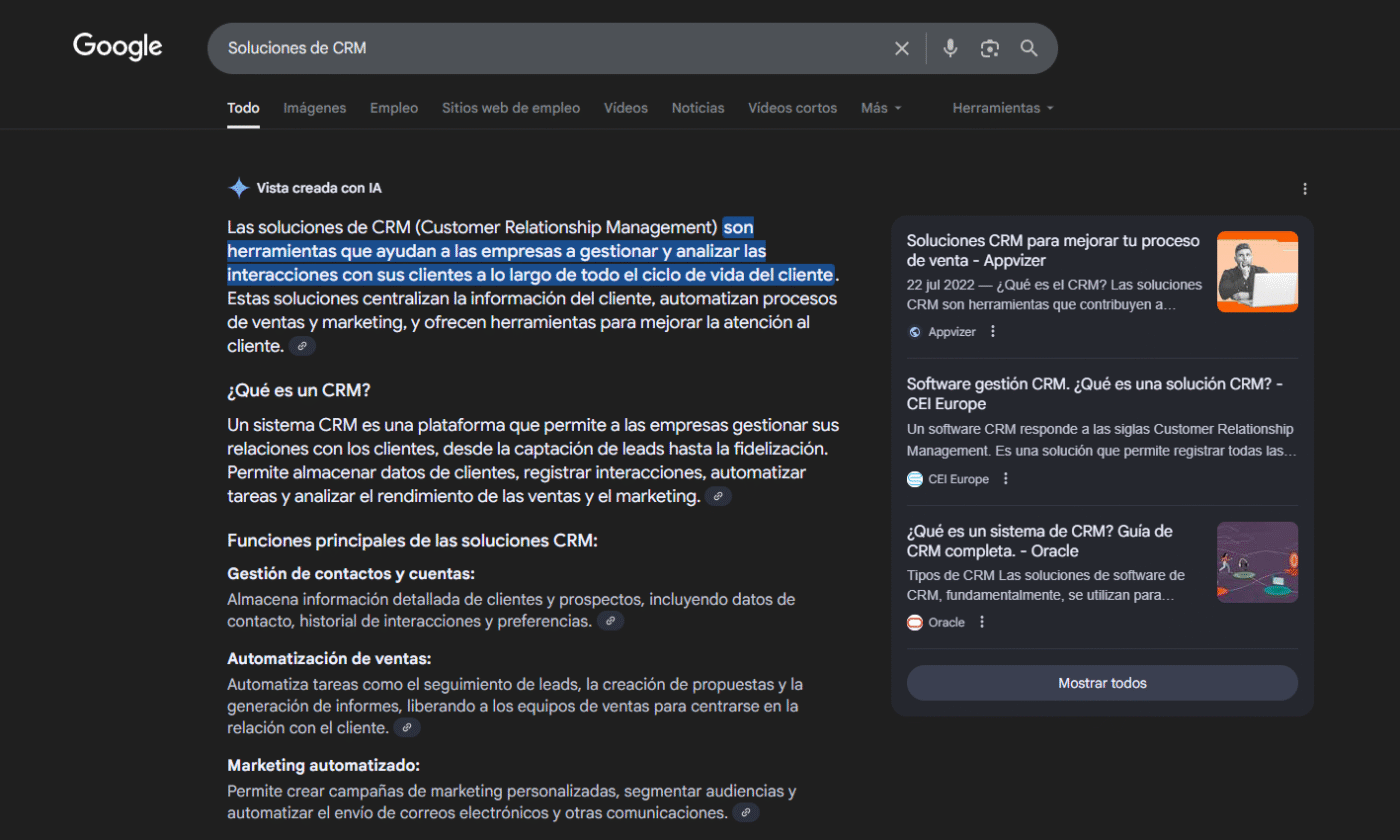
Spanish SERP with active SGE defining CRM and functions](sandbox:/mnt/data/Capture 4.PNG) Fig. 3 - Generic Spanish query (“Soluciones de CRM”): Active SGE with definition and functions. Screenshot taken in August 2025 (Spain, desktop, session not logged in).
To top it all off, Search Engine Journal highlights that the coverage of BMS varies significantly by sector and that, in the case of the financial searches, for example, only reaches a 47 %, compared to more than 90 % in sectors such as beauty, automotive or eCommerce (Search Engine Journal, 2024). See Fig. 4.
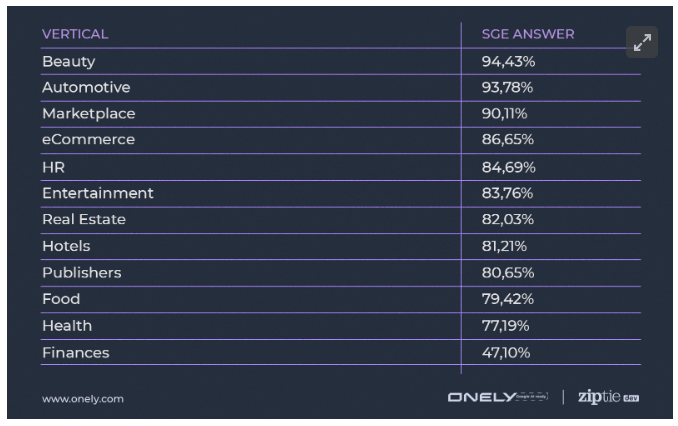
Table of SGE coverage by vertical (Onely/Ziptie)](sandbox:/mnt/data/Capture 3.PNG) Fig. 4 - SGE coverage by vertical (source: Onely/Ziptie; cited by Search Engine Journal). Image referenced; methodology in original study.
At this point, I invite you to do your own tests by trying to simulate those phrases for which you think your potential customers should search for you on Google.
What is clear is that, although the SGE does not yet affect all verticals equally and depends on many factors for its activation, all indications are that it will Google will gradually expand its coverage, and brands need to prepare for that scenario.
Therefore, if your content is not optimised to be understood and cited by AI, you could lose visibility just when your industry starts to be impacted.
No clicks. No forms. Without giving you the opportunity to capture that lead.
What it means for your B2B company and what to do now
Your sector is already in the SGE's sights: uncertainty is not if affects, but how much is affecting your visibility and conversion today. That is why it is important to act urgently. The priority is for your brand to be citable by Google's AI and that your authority signals and data are ready to be interpreted by intelligent systems.
At Rotata we help companies like yours respond to this change with concrete actions. This is the unified, actionable and prioritised plan:
- Diagnose your visibility and authority.
- Check mentions and backlinks (incoming links from other websites) and citations in industry media/portals.
- Check if your content is referenced by third parties and if you are listed as a source.
- Refocus content on authority and response.
- It starts with a straightforward answer and follows with explanation, lists and FAQs (frequently asked questions) that are easy for the AI to quote.
- Use basic structured data and clear formats (tables, videos, own studies).
- Prepare your data and rationale.
- Integrate CRM and analytics; maintain consistent product/service names and clean data.
- Ensures that key information is accessible and consistent at all points of contact.
- Activate AI and measure impact with simple metrics.
- Use tools such as ChatGPT, DataRobot or Breeze to optimise content and detect intent, and train the team to use them judiciously.
- It follows visibility (appearances/citations in SGE) and business (MQL, Marketing Qualified Leads, and funnel speed) and adjusts.
- Prioritise key accounts (ABM, Account-Based Marketing) and personalisation.
- Define target companies and messages by profile; automate multi-channel prospecting.
- Orchestrate campaigns that respond to signals of intent, not just keywords.
Act now: the sooner you measure and adjust, the less reliance you will have on sudden changes in the generative SERP (SERP).
Conclusion: from passive spectator to protagonist of your digital visibility
As the person responsible for generating business, you are probably asking yourself: “And is this going to help us sell more?” The answer is yes, visibility is no longer a matter of being there, but of being chosen by intelligent algorithms that prioritise relevance, consistency and experience.
AI isn't replacing SEO; it's transforming it into something more complex and challenging. But also fairerThe winner is no longer the one who produces the most content, but the one who provides the most value to the user.
Adapting fast makes the difference between leading or falling off the radar. Your industry is already in the crosshairs of generative AI; what is not yet clear is how much SGE is affecting your visibility and conversion today. It is precisely because of this uncertainty that you should measure, experiment and adjust now, before the impact is fully visible and the rules of the game change completely.
You you can wait for Google to rewrite the terms of digital visibility, or you can anticipate. Preparing your company for this transition is not just an advantage: it is a strategic necessity.
At Rotata we not only help you understand this new scenario, but we also apply it to your own sales funnel. From the creation of content designed for AI to the automation of your pipeline with intelligent tools, we accompany you to lead in this new stage.
Want to know how to prepare for Google SGE and protect your visibility?
Schedule a free diagnostic session here and let's analyse together your digital positioning in the post-SEO era. Agenda.
